For years, fashion brands have treated social media as the ultimate storefront. Instagram became the mood board, TikTok became the trend forecaster, and Pinterest became the place consumers went when they wanted to figure out what they were supposed to be wearing next.
But something interesting is happening is fashion retail: the physical store is starting to borrow the qualities that made social media so addictive in the first place.
Shopping is no longer simply about walking into a store, finding a product, trying it on, and checking out. Increasingly, consumers want a reason to be there. They want a discovery. They want personalization. They want something worth photographing, talking about, or sharing, They want to interact with people, brands, and products in a way that feels more personal than scrolling through a screen.
In 2026, the smartest retailers are recognizing that the store doesn't have to compete with social media. It can become the physical version of it.
From Storefront to a Social Space
The traditional fashion store had a relatively straightforward purpose: display merchandise and facilitate a purchase. That model feels increasingly outdated now. Consumers can now see almost any product online before they ever enter a store. They can compare prices, read reviews, watch a try-on video, see how an item looks on someone with a similar body type, and sometimes have it delivered the same day.
That means the physical store has to offer something the internet can't.
According to Vogue Business, retail strategy in 2026 is increasingly focused on service, relevance, and emotional resonance rather than creating elaborate "experiential" spectacles. Customers may come into a store because of a product, but what keeps them there can be a stylist who remembers them, a unique assortment, an art installation, a cafe, or an event. This is an important distinction.
The future of retail isn't necessarily about making stores bigger or more technologically advanced. It is about making then more meaningful.
The New Store is Designed to be Experienced
Think about what makes someone stop scrolling on TikTok or Instagram. It is usually not simply the product. It is the styling, environment, personality, story, and unexpected detail. Physical retail is beginning to operate in exactly the same way.
A fashion store can become a place where customers attend a styling event, discover a new designer, meet a creator, grab a coffee, take photos, and build an outfit or simply spend time with friends. Fashion retailers are increasingly experimenting with these hybrid concepts. Recent retail openings have incorporated restaurants, cafes, wellness spaces, cultural programming and other activities alongside merchandise. Vogue reported that industry experts expect more brands to adopt multipurpose stores that function as social venues, cultural spaces, and lifestyle destinations.
That changes the psychology of shopping.
You are no longer saying "I need to go to the store", You are saying "Let's go to the store". It may seem small, but that difference is huge.
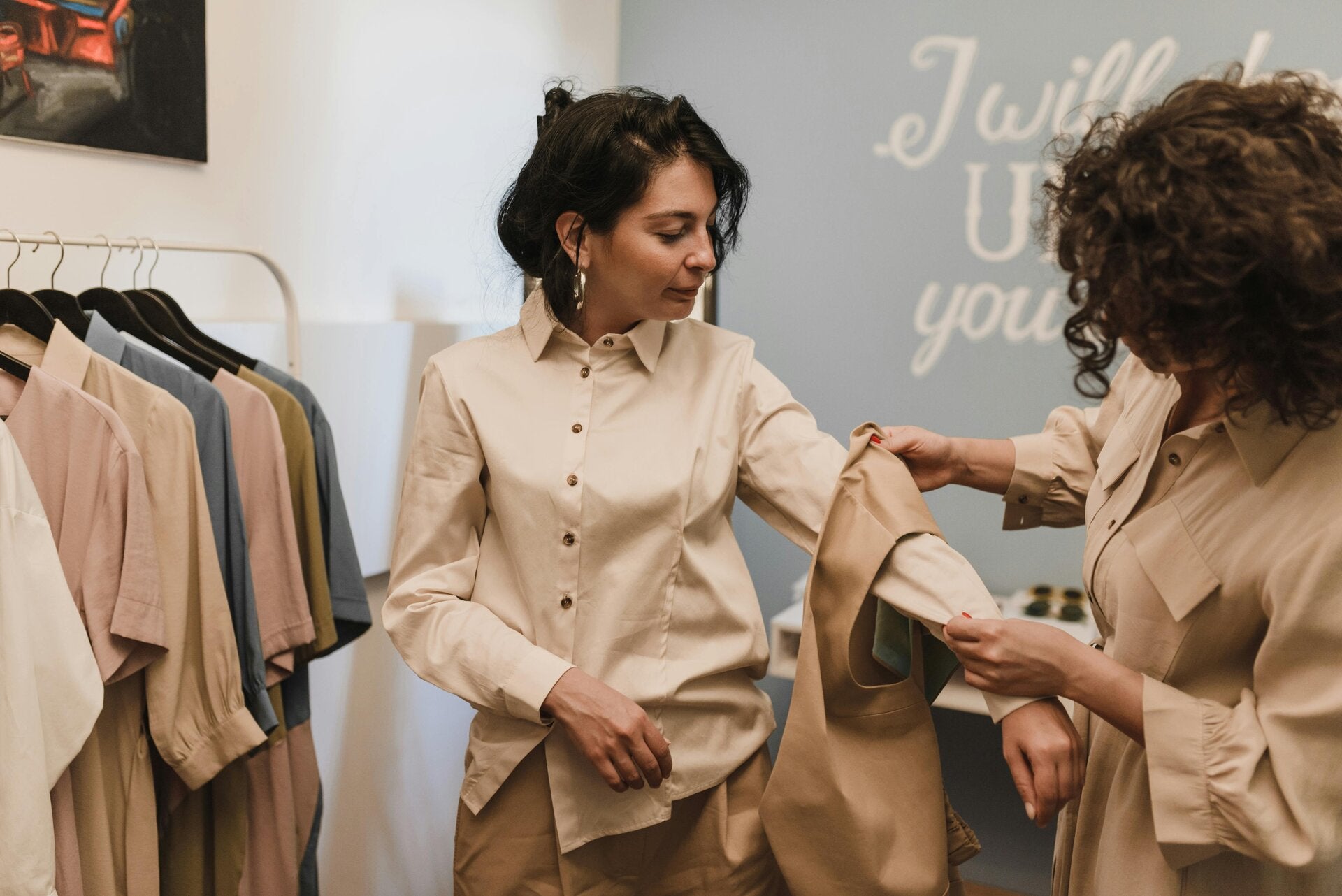
Your Sales Associate Might Be More Important Than Your Algorithm
Ironically, one of the biggest advantages physical retail has over social media isn't technology. It's people.
Online shopping can tell you that a dress is trending. An algorithm can recommend another dress based on what you have purchased in the past. But a good salesperson can look at you and say "That silhouette is actually much better on you than the one you picked". They can remember that you are shopping for a wedding next month. They can pull a jacket you wouldn't have noticed. They cal tell you that the pants you are holding run small. They can build an entire outfit instead of showing you one product.
That human element is becoming increasingly valuable because consumers are already overwhelmed by recommendations online. Research published in 2026 on fashion retail found that physical and digital experiences are increasingly intertwined, with personalization and sensory experiences online influencing how consumers experience physical stores. In other words, technology can bring the customer into the store, but human interaction can be what makes them stay.
This is especially significant for specialty fashion retail. The sales associate isn't simply processing a transaction anymore. At their best, they are acting as a stylist, curator, trend translator, and personal shopper.

The Phone is Coming Into the Store With You
Calling the store the "new social feed" doesn't mean customers are putting their phones away. Actually, it is the opposite.
The modern shopping experience is becoming increasingly phygital- physical and digital at the same time. A customer might discover an outfit on TikTok, save it to Pinterest, check the brands website, visit the store to try it on, post it through Instagram, and then purchase it in person. The journey isn't online OR offline.
It is:
Online-> Offline-> Online-> Purchase-> Social Sharing
A 2026 study of young fashion consumers found that smartphones remain central throughout the store journey, including both planned purchases based on online research, and spontaneous inspiration driven browsing. That means retailers shouldn't necessarily be trying to eliminate phones from the shopping experience. They should be asking:
How can we make the physical experience worth putting on camera?
The Rise of "Instagrammable" Stores - But Better
There is, of course, a danger in this trend. For a while, "experimental retail" became synonymous with creating enormous pink wall, neon signs, or oversized logos specifically so customers would take a picture. That can work, but it is not enough anymore. Consumers can tell you when an experience feels manufactured. The strongest stores are not simply creating instagrammable moments. They are creating environments that are genuinely interesting enough to capture a photograph naturally.
A limited edition collection, a local artist installation, a customization station, a styling event, etc.
These details give customers something to talk about rather than simply something to photograph. That distinction matters, because the most powerful retail marketing increasingly happens after the customers leave the store. The customer becomes the content creator.
Retailers are Turning Customers Into their Marketing Department
Social commerce has already blurred the line between customer and marketer. A customer buys a jacket, posts an outfit, tags the brand, and suddenly hundred of people have seen the product without the brand purchasing traditional advertising.
Physical stores an amplify that effect.
Imagine a customer walking into a store an finding a beautifully styled display of pieces that aren't necessarily merchandised together online. They try everything on, a sales associate helps style the look, she takes a mirror selfie and posts it. Her friend asks her where she got the outfit and visits the store the following week. The store has essentially become a social media post you can walk into. That is where physical retail has become incredibly powerful.
PwC's 2026 retail monitor describes social commerce as increasingly blending inspiration and transactions into a single consumer journey, while retailers are also experimenting with in store spaces designed around content creation. They physical store isn't replacing social media. It is feeding it.
Community is Becoming a Part of the Product
One of the biggest changes in modern retail is the realization that people don't necessarily want to shop alone. They want to go places together. Fashion has always had a social component, but today's retailers are making that social component more intentional.
Events can turn a store into a community:
- Designer Trunk Shows
- Styling appointments
- Fashion workshops
- Beauty events
- Pop-ups
- Influencer appearances
- Launch parties
- Private shopping events
These experiences create something on online checkout page can't: a memory. And memories are much harder to replace with another retailer's 20% off coupon.
The Department Store Could Actually Benefit from This
This shift is particularly interesting for department stores and specialty retailers. For years, department stores have faced the wuestion of why customers should physically visit when they can shop the same categories online.
The answer increasingly is not simply "because we have the product"
Amazon has the product.
The Brand's website has the product.
TikTok shop has the product.
The reason to visit is what happens around the product.
A department store can offer hundreds of brands in one physical environment, but its greatest advantage may be the ability to provide something online marketplaces struggle to replicate: human curation
Instead of asking customers to navigiate thousands of products, a strong sales team can edit the selection for them.
These are three dresses you should try. This shoe works better with this silhouette. Here is a bag that pulls the entire outfit together.
Suddenly, the store becomes less like a warehouse and more like a physical fashion editor. That is an incredibly compelling position.
There is a Catch
The phrase: "experiential retail" can become dangerous when retailers misunderstand what consumers actually want.
Customers don't necessarily need a DJ, a coffee shop, a photo booth, and a giant digital screen every time they shop. Sometimes they just want good service. They want the right size available. They want someone to actually acknowledge them. They want a dressing room that isn't a mess, employees who know the merchandise, to find something without feeling overwhelmed, and they want to feel like their time matters.
In fact, Vogue's 2026 retail analysis makes this exact point: the industry may be moving away from the buzzword "experiential", but the underlying idea- creating emotional, memorable and service- driven experiences- is becoming more important
The future of retail doesn't necessarily need to be louder. It needs to be better.
The New Competitive Advantage: Being Worth The Trip
The biggest challenge facing physical fashion retail isn't convincing people that stores exist. It is convincing them that the trip is worth it.
Online shopping is convenient. Physical shopping has to be valuable. That value can come from expertise, discovery, exclusivity, community, entertainment, or it can simply come from the feeling of finding something you didn't know you wanted. The last part might actually be the most important.
Algorithms are incredibly good at showing us more of what we already like, but stores can still surprise us. You can walk into a store looking for a black dress and walk out with a completely different outfit because someone introduced you to something you would have never clicked on online.
That element of surprise is one of physical retail's greatest remaining superpowers.
Is the Store Really The New Social Feed
Not exactly.
Social media will continue to dominate fashion discover, trend acceleration, and cultural conversations. But the relationship between social media and physical retail is changing. The store is becoming a physical extension of the feed- a place where digital trends become tangible, where content becomes experience and where consumers can interact with products rather than simply seeing them on a screen.
The most successful retailers of the future may not be the ones that choose between digital and physical. They will be the ones that understand that there isn't really a line between the two anymore.
The customer might discover the brand through TikTok. The algorithm might convince her to visit. The store might convince her the buy. The sales associate might convince her to come back. And her instagram post might convince five more people to come in to do the same. That is the new retail cycle. The store is no longer just where the transaction happens. It is where the story begins.
In the fashion industry increasingly built around attention, community, and personal connection. That might be the most valuable thing a retailer can sell.
Add comment
Comments